
























Outstaffing workforce: mass recruitment of workers to Europe
A full cycle of recruitment, paperwork, and workforce support for labor agencies. From candidate sourcing to the first day on the job, everything runs in one system.
For labor agencies and employers: mass recruitment of workers to Europe "turnkey"
All stages, documents and statuses are available in your account.

What is included in the relocation package for a $2,500 applicant
- Candidate qualification and screening
- Contract and payment control
- Processing of documents/fees/invitations (if applicable by country - free of charge)
- Accompaniment before visa/residence permit and departure
- Coordination of logistics/arrival/check-in
- Recording stages and documents in ERP/CRM
Launch of mass recruitment of workers,familiarize yourself with the cost, economics and timing.
We are launching an “online factory” that covers the key tasks of mass recruiting: candidate flow, qualifications, relocation sales, documents, stage control - and transfer to coordination after arrival.
In more detail, you can familiarize yourself with our cooperation model briefly and concisely in 6 points.
For labor agencies
We recruit mass workforce for blue-collar roles at construction sites, factories, warehouses, and other industries.
-
Scale:
- Minimum volume to launch a flow of 176 candidates monthly, depending on the geo and conditions for candidates
- Conditions depend on the country, vacancies, terms and registration model
-
One-time payment for the relocation tariff by a job seeker:
- Dividable amount between you and us, relocation package from $2,500 or EUR 2,100 paid by the applicant - relocant
-
Cooperation terms for recruiting agencies:
- The agency transfers 50% of the margin to Camels for each candidate hired through our “online factory”. Payments are made regularly while the employee is working
- Deploying the operating model takes up to 2 months to achieve a stable flow of 176 candidates per month.
-
Candidates' hiring deadlines:
- The processing time for documents/visas/residence permits and the candidate’s return to work takes up to 3 months from the date of purchase of the relocation tariff
- From the 4th month, the candidate starts work
What does the agency receive from each candidate?
For every $2,500 relocation fee paid by a candidate, the agency receives:
- $300 compensation for paperwork. Funds go to targeted expenses
- $300 bonus to the agency for each transaction. It is this income that pays for the start-up payment and generates profit.
Camels share per working hour for Benelux and Germany
We only take into account actual expenses for employee salaries, taxes and housing
- Simple workers minimum €2.70/hour or 50% of profits if this is above the minimum
- Qualified specialists: welders, electricians, etc. minimum €10/hour or 50% of profits if this is above the minimum
Monthly income in the first year from launch
Why the first payment is not an expense but an investment
Who does what

 Agency/employer
Dirty margin calculator for mandatory expenses employment agencies
Select a suitable country and economic model with a design scheme.

 Employment through Poland
Obligation costs: €19.02–€35.36/hour
Margin: €4.56–€8.73/hour.
Camels share = 50% margin → €2.70–€4.37/hour.
At the lower limit, a minimum of €2.70/hour applies.
Obligation costs: €19.02–€35.36/hour
Margin: €4.56–€8.73/hour.
Agency share 50% → €1.86–€4.37/hour.
At the lower limit of the margin, Camels takes a minimum of €2.70/hour, leaving the agency with €1.86/hour.

 Employment through Lithuania
Obligation costs: €16.35–€30.28/hour
Margin: €7.50–€12.87/h.
Camels share = 50% margin → €3.75–€6.44/hour.
Obligation costs: €16.35–€30.28/hour
Margin: €7.50–€12.87/h.
Agency share 50% → €3.75–€6.44/hour.
Employment through Poland
Obligation costs: €18.13–€33.58/hour
Margin: €5.56–€9.94/hour.
Camels share = 50% margin → €2.78–€4.97/hour.
Obligation costs: €18.13–€33.58/hour
Margin: €5.56–€9.94/hour.
Agency share 50% → €2.78–€4.97/hour.
Employment through Lithuania
Obligation costs: €15.61–€28.80/hour
Margin: €8.33–€14.27/hour.
Camels share = 50% margin → €4.17–€7.14/hour.
Obligation costs: €15.61–€28.80/hour
Margin: €8.33–€14.27/hour.
Agency share 50% → €4.17–€7.14/hour.
Employment through Poland
Obligation costs: €20.30–€37.62/hour
Margin: €4.37–€8.64/hour.
Camels share = 50% margin → €2.70–€4.32/hour.
At the lower limit, a minimum of €2.70/hour applies.
Obligation costs: €20.30–€37.62/hour
Margin: €4.37–€8.64/hour.
Agency share 50% → €1.67–€4.32/hour.
At the lower limit of the margin, Camels takes a minimum of €2.70/hour, leaving the agency with €1.67/hour.
Employment through Lithuania
Obligation costs: €17.47–€32.24/hour
Margin: €7.48–€12.82/hour.
Camels share = 50% margin → €3.74–€6.41/hour.
Obligation costs: €17.47–€32.24/hour
Margin: €7.48–€12.82/hour.
Agency share 50% → €3.74–€6.41/hour.
Holiday allowance 8% can reduce margin by ≈ €1.18–€2.24/hour.
Your business plan for monthly income in different scenarios with 1760 employees
Economic summary of three scenarios from positive to negative, team, number of working hours, costs, risks and profits.

Team in Warsaw - Lean €76,639 / FTE 26
Team in Warsaw - Lean €76,639 / FTE 26
Office in Warsaw - back office support
Team in Germany - Lean €89,295 / FTE 21
Team in Germany - Lean €89,295 / FTE 21
Office in Germany - site/coordination
Other expenses - Lean €88,000
Team in Warsaw - Standard €104,387 / FTE 36
Team in Warsaw - Standard €104,387 / FTE 36
Office in Warsaw - back office support
Team in Germany - Standard €109,566 / FTE 26
Team in Germany - Standard €109,566 / FTE 26
Office in Germany - site/coordination
Other expenses - Standard €88,000
Team in Warsaw - Max €130,788 / FTE 46
Team in Warsaw - Max €130,788 / FTE 46
Office in Warsaw - back office support
Team in Germany - Max €129,837 / FTE 31
Team in Germany - Max €129,837 / FTE 31
Office in Germany - site/coordination
Other expenses - Max €88,000




Why with us grow faster
- We become not just a contractor for one stage, but an ally who is interested in the same result: more people at work, greater volume, and a stronger market.
- Camels covers attraction, qualification, sales, documents, and digital control, while you strengthen the local operation, the contract with the site, and the workers' arrival on location.
- Behind the model stands not one department, but a full structure: B2B sales, affiliate marketing, recruiting, management, development, sales, and the franchise direction.
- Thousands of partners working under CPS and RevShare models help scale the candidate flow faster than a classic agency can do on its own.
- The franchise network provides an extra volume reserve and reduces the risk of hitting the ceiling of internal resources.
- As a result, you get not just vacancy closure, but a system with which you can scale systematically and capture the market.

Still have questions?
Get answersWhat does the agency see? in our ERP+CRM

Candidate profiles and all documents: passport, certificates, licenses, portfolios, application forms

Registration statuses by stages with convenient notifications

Agreements with applicants/employees and visa/residence permit documents

Payment confirmations: duties, fees and invoices

Documents and invoices for employees: a signed employment contract with the employee, salary invoices for the employee.

Uploaded contracts between the enterprise and your agency, which are visible only to us and you, as well as invoices for the receipt of funds from enterprises to agencies for each employee

History of changes, control of who/when/what was uploaded and a schedule of payments to employees and constant updating of functionality
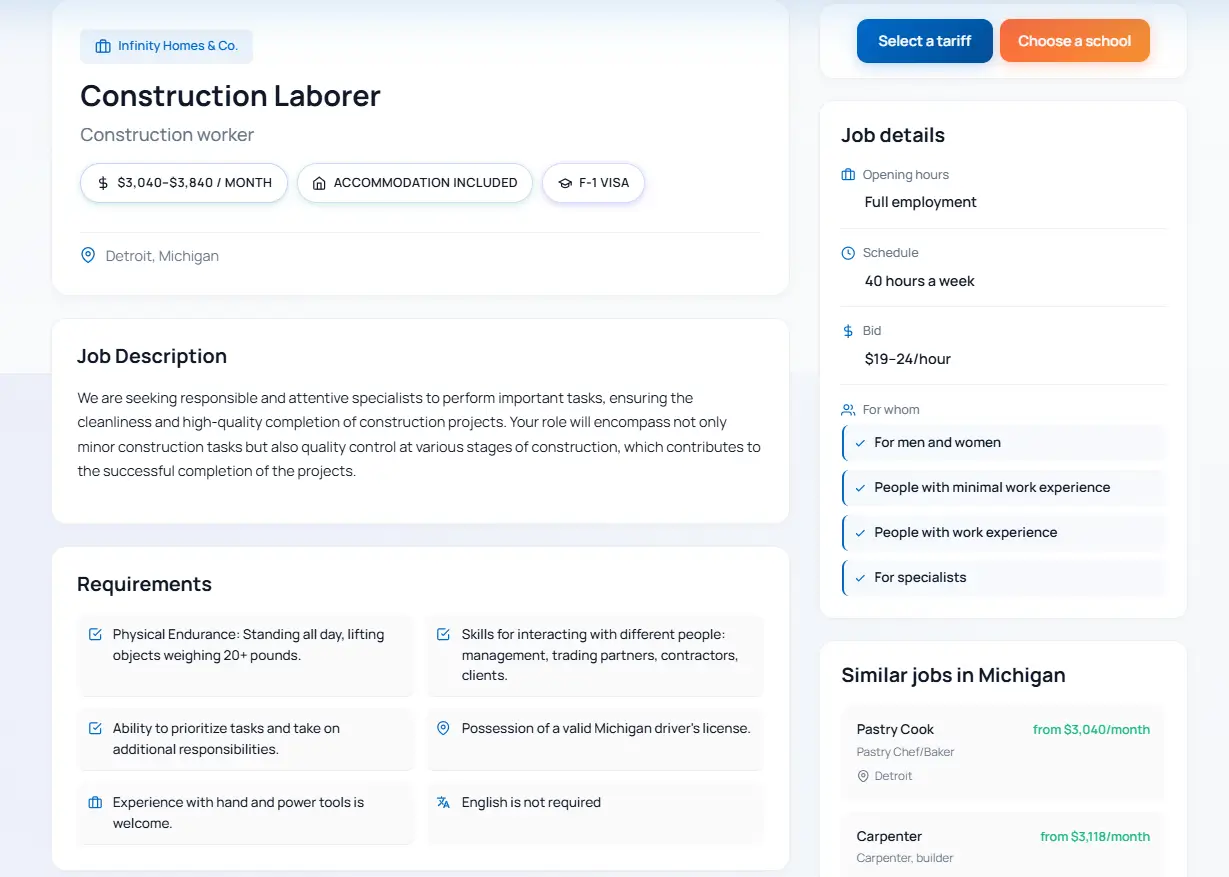
What does a vacancy look like? for the candidate


Don't have money to scale your outstaffing agency? Find investments and share!
The investor will cover all expenses and move into profit within 12-16 months. Below is the revenue table for your agency with 1,760 employed workers.
Questions and answers for: labor agencies and employers
Turnkey mass recruitment of workers to Europe

This block is designed for labor agencies and direct employers who need not one-off hiring, but a stable, scalable model for placing workers on sites in Europe with clear economics, transparent paperwork, and control at every stage.
1 What does "turnkey mass recruitment of workers to Europe" mean in your model?
This is a model in which we take over the entire upper and middle part of the funnel: candidate attraction, initial qualification, screening, relocation package sales, document preparation, support up to the visa or residence permit, and stage control up to departure. After arrival, the candidate is handed over to your operation: coordinator, housing, logistics, and placement on site. For you, this is not a chaotic flow of applications, but a managed process: candidate -> screening -> contract -> payment -> documents -> departure -> start of work.
2 What is the minimum volume required to launch?
The minimum volume for launching a stable flow is from 176 candidates per month. Below this threshold, the model usually does not provide the required flow density and reveals the economics of the project worse. We view mass recruitment not as one-time vacancy closures, but as a systematic operating model.
3 How long does it take to launch before the first workers reach the site?
Deploying the operating model takes up to 2 months. Then the processing cycle begins: sale of the relocation package, documents, visa or residence permit, departure. On average, the first candidates start work 3-4 months after launch.
4 From which regions do you attract candidates?
The main flow is formed from South America, Asia, and CIS countries. This allows us not to depend on one market, to build a broad flow for different vacancies, and to adapt recruitment flexibly to the country, schedule, and conditions of a specific employer.
5 What stays on our side and what do you do?
We are responsible for candidate flow, qualification, sale of the relocation package, documents, stage control, and support up to departure. On your side are the contract with the site, the local operations team, housing, coordinators, logistics, adaptation, and control of the worker's first day on site.
6 Why is this model more profitable than the usual manual search for people?
Because you do not build a separate marketing, recruiting, and visa process from scratch. You connect to a ready-made system where the funnel, documents, statuses, and control are already established. This lets you scale faster, avoid wasting time on manual operations, and work like a system rather than a set of fragmented actions.
7 How is our revenue formed in this model?
Your revenue consists of several parts. The first is a fixed $300 bonus from each deal, which helps pay back the launch and provides quick margin. The second is income from the hourly model after the candidate starts work. The third is the budget for document preparation, which is reserved for the candidate's legal and immigration expenses.
8 What is the relocation package and why does the candidate pay for it?
The relocation package is a set of services for relocation and document support: qualification, contract, payment control, documents, invitations, fees, support up to the visa or residence permit, departure, and stage tracking in ERP/CRM. The reference price is $2,500 or about EUR 2,100. This model improves candidate discipline, filters out weak motivation, and reduces churn after arrival on site.
9 How is the margin split between the agency and Camels?
The basic logic is 50/50 of the actual margin after mandatory expenses are deducted: wages, taxes, and housing. At the same time, Camels has a minimum threshold for basic workers from EUR 2.70 per hour, and for qualified specialists from EUR 10 per hour, if 50% of the actual profit gives a lower amount. This makes the model transparent and predictable for both sides.
10 When do monthly payouts for active candidates start?
Usually, monthly revenue begins in the 4th month after the candidate pays for the relocation package. The first months go to the contract, documents, visa or residence permit, flight, and actual start on site. After that, the hourly economics kick in.
11 Why does profitability differ by country and employment scheme?
Because the final margin depends on the country, the contract rate, the payroll fund, employer contributions, housing cost, and the employment scheme. One model may be more familiar but less profitable, while another may provide better economics due to a lighter payroll burden.
12 When does the project reach payback?
In the base model, payback is expected in about 9 months if the volume, document processing pace, and candidate arrivals to sites are maintained. From the 4th month onward, regular payouts from active workers start to accumulate, and then the scale effect becomes noticeable within the first year.
13 Is it legal to charge a candidate for the relocation package?
Yes, if it is formatted correctly. In the EU, there are restrictions on charging fees specifically for employment, so payment should not be formalized as a fee for a vacancy, but as a service or relocation package under a separate agreement. That is, the candidate pays for support of the process, and not the fact of access to the job itself.
14 Who prepares the documents for the visa and residence permit?
We are fully responsible for preparing the package of documents: application forms, fees, submission kit, loading control and support through the stages, and you are responsible for the invitations. You get a process that is already managed and transparent, rather than having to build a separate visa department within the agency.
15 Through which jurisdictions can workers be employed?
The basic model considers Poland and Lithuania in particular. Poland is a more familiar scheme for some employers, but with a higher burden on individual expenses. In a number of scenarios, Lithuania provides a more profitable project economy. The final choice is made based on the contract, the country of the object and the real margin.
16 What legal guarantees do we receive when working with you?
All key conditions are fixed in a bilateral agreement: stages of work, deadlines, financial model, responsibility of the parties, document flow rules, sanctions and procedures for resolving disputes. Additionally, the entire candidate path is reflected in the system: statuses, documents, payments and history of changes.
17 Who is responsible for data accuracy and stage control?
We are responsible for qualification, verification and support for our part of the process. You are responsible for your operational side after the candidate arrives and for interaction with the object. This model separates areas of responsibility and reduces chaos when everyone is trying to control everything at the same time.
18 What exactly do we see in your ERP/CRM?
You see candidate profiles, documents, registration statuses, contracts, payment confirmations, visa and migration stages, history of changes, actions on the case and key working documents after the person returns to work. This is a single control loop, and not a set of tables and correspondence.
19 How do we track which stage each candidate is at?
For each candidate, a specific status is recorded: application form, verification, decision, contract, payment, visa package, departure, arrival, employment contract, confirmation of employment. Due to this, you see not only the result, but also the bottlenecks in the moment.
20 Who handles housing, logistics, and adaptation after arrival?
We accompany the candidate until his arrival. After arrival, responsibility passes to your local operation: housing, transportation, coordination, adaptation and delivery to the site. This makes sense because you are the one who manages the relationship with the employer on site.
21 Can we work with you if we already have our own managers, coordinators, and processes?
Yes. Our system does not interfere with your internal structure, but enhances it. You receive a transparent flow of candidates, statuses and documents, and your managers and coordinators work with a clear operational picture.
22 What happens if a candidate quits or fails to stay in the first months?
This scenario must be described in advance in the contract: replacement, recalculation or other compensation logic are discussed individually. For us, this is not a minor topic, but part of the quality of the funnel. The better the selection and motivation of the candidate at the entrance, the fewer early losses after entering the site.
23 How do you reduce the risk of disruptions and chaos in the process?
Due to separation of roles, transparent ERP/CRM, fixed stages, uniform statuses, document control and an understandable financial model. This reduces wasted time, reduces the number of controversial situations and makes the project manageable even with large volumes.
24 Why is your benefit from working with Camels higher than from the usual work with local contractors?
Because we do not sell a one-time service to find people, but connect you to an already built system of mass recruitment. While small competitors work the old fashioned way - manually, fragmentedly and without a common structure - our processes are divided by function and team. For the partner, this does not mean chaos, but a predictable, scalable process.
25 Why do you call this model an online factory?
Because the result here is built not on one strong manager and not on random sources of candidates, but on a systemic connection of departments, processes and digital control. In order to consistently bring in the flow, qualify candidates, bring them to a deal and put them to work, we simultaneously operate B2B sales, affiliate marketing, management, recruiting, sales, development and direction of franchisees. This is what makes the model production, and not manual.
26 What allows you to confidently deliver volumes rather than just promise scale?
Because we have not only an internal team, but also an external partner network. We are not dependent on one traffic channel, one recruiter or one market. The flow is formed through a network of partners who attract candidates using the CPS and Revshare models. This makes it possible to scale the volume much faster than a classic agency that looks for people only on its own.
27 Why is this strategically beneficial for us, not just for a single deal?
Because our interests coincide. You need a steady stream of workers coming onto the site. We need a stable volume that passes through the system efficiently. The more candidates reach the deal and actually go to work, the stronger both your economy and ours become. We do not compete with each other within the same transaction, but jointly strengthen our positions and take the market away from less systemic players.
28 How many resources really stand behind this model on your side?
To maintain a stable flow and manageable process, we employ more than 70 people on staff. This is not one team of recruiters, but several areas at the same time: B2B sales, affiliate marketing, management, development, franchisees, recruiting and sales. This is why we can build volume as a system, and not as a set of isolated actions.
29 Why does this give us an advantage over smaller competitors?
Because small-scale competition most often works according to the old model: one or two recruiters, manual search, weak control over stages, dependence on individual people and the absence of a common digital system. This model does not withstand growth well and quickly begins to fail on volumes. Our structure was initially built for mass flow, status control and separation of functions. Due to this, we are growing faster and can take larger volumes.
30 How are you able to attract candidates from different countries and in large volumes?
The key advantage is the affiliate network. It allows you to attract thousands of partners around the world: webmasters, recruiters and other participants who bring candidates and receive payments via CPS and Revshare. This creates a distributed acquisition model where the flow does not depend on one office or one region.
31 What does the partner-network franchise add, and why is it needed in this model?
Franchising increases scale and reduces the risk of volume shortages. Franchisees receive income from each CPS partner and are interested in expanding the network of recruiters and webmasters who attract candidates remotely. This creates an additional scaling layer on top of the main system. For you, this means less risk that the flow will hit the ceiling of our internal resources.
32 How does the franchise reduce risk for the agency or employer?
If the main flow begins to slow down in some direction, the model does not stop at one source. Additional scaling is included through franchisees, whose task is to constantly expand the network of partners and strengthen the attraction of candidates. Simply put, a franchise is not a separate product to the side, but a safety margin for the entire system of mass recruitment.
33 Why can long-term expansion be built with you rather than just closing one contract?
Because we have three levels of growth at the same time: an internal team, a partner network and a franchise network. This allows not only to fulfill the current volume, but also to increase capacity for new facilities, new countries and new categories of personnel. For a partner, this turns cooperation from a one-time deal into a long-term tool for business expansion.
34 What is the main benefit of the alliance between you and Camels?
The main benefit is that we cover different parts of one large machine. You handle the contracts, ground operations, coordinators, housing, and control of going to work. We handle flow, qualification, relocation sales, documents, digital control and scaling through a partner and franchise network. As a result, together we become not just performers for each other, but strong allies that systematically grow and absorb the market, while less organized players continue to work according to old schemes.
35 Why is it more profitable for us to work with you long term instead of looking for separate contractors for each stage?
Because siled contractors almost always create gaps between marketing, qualification, sales, paperwork, and operations. We are building one coherent model, where each stage is subordinated to a common goal: to bring the candidate to work and maintain the economics of the project. This is stronger than a collection of individual performers.
36 What is our shared benefit as allies?
Our model is built so that both parties earn money not on a one-time transaction, but on a growing volume. You get flow, transparency and zoom. We get a long-term operating partner. As a result, we do not compete with each other for the same piece of margin, but together we expand the volume, take over new objects and strengthen our position in the market.
37 How quickly can the project be scaled after launch?
If the basic operating model is built correctly, scaling occurs through an increase in the number of objects, geographies and types of vacancies. The most important thing is to first stabilize the quality on the first stream, and then expand the volume without losing control. That is why we are not building a one-time set, but a system.
38 Can new countries and new businesses be added after the first launch?
Yes. Once the basic model has been worked out, it becomes easier to connect new objects, test other registration jurisdictions and increase the flow. This turns the project from a single contract into a scalable asset.
39 Who is this model best suited for?
It is best suited for agencies and employers who think big, are willing to work systematically, and understand the value of a long-term operating model. If you need a one-time selection for several people, this structure is redundant. If the goal is to build a stable flow, an understandable economy and jointly strengthen positions in the market, this model is most suitable.
40 What does the partner receive besides the candidates themselves?
The partner receives not only a flow of people, but also an operational support: a control system, transparent document flow, an understandable financial model, separation of roles and an ally who is interested in the same result. This makes collaboration not a one-time service, but the foundation for long-term growth.